
Go to the U of M home page

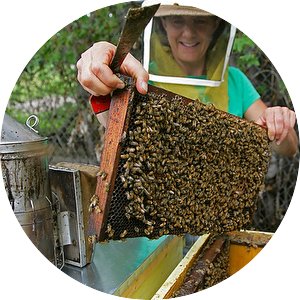
Marla Spivak

Distinguished McKnight University Professor
Apiculture / Social Insects

ENTO.Marla.PhotoOffice location

Room 530A Hodson Hall

Mailing Address

219 Hodson Hall, 1980 Folwell Ave.
University of Minnesota
St. Paul, MN 55108

Phone: (612) 624-4798
FAX: (612) 625-5299

E-mail: spiva001@umn.edu

Website: www.beelab.umn.edu

Education:

B.A. Humboldt State University, Arcata, CA, 1978, Biology

Ph.D University of Kansas, Lawrence, KS, 1989, Entomology

Research Interests:

My goal is to promote the health of honey and native bee pollinators. My interests range from basic research on mechanisms of social behaviors to practical collaborations and courses to help beekeepers to improve bee breeding and management practices.

Currently, students and I are focusing on 1) the benefits of propolis (tree resins) to the immune system of bees, 2) the potential activity of propolis against bee viruses and Varroa mites, 3) the role of Nosema disease in Colony Collapse Disorder, 4) a historical survey of Osmia orchard mason bees in MN, 5) the impact of floral resources on pollinator health and diversity in the Prairie Pothole Region of North Dakota, and 6) assisting MN, ND, and CA queen bee producers in breeding bees for resistance to diseases and mite pests.

Teaching:

Beekeeping Courses for the Public (register through www.beelab.umn.edu):

Honors & Awards:

Recent Publications

For more, including Extension publications: www.beelab.umn.edu

Simone-Finstrom, MD, Spivak M. 2012. Increased resin collection after parasite challenge: A case of self-medication in honey bees? PLoSOne 7(3): e34601. doi:10.1371/journal.pone. 0034601

VanEngelsdorp, D, Tarpy, D, Baylis, K, Spivak , M, et al. 2012. The Bee Informed Partnership: Using beekeepers’ real-world experience to solve beekeepers’ real-world problems. Amer Entomologist 58: 116-118.

Spivak M, Mader E, Vaughan M, Euliss, NH Jr. 2011. The plight of the bees. Environ. Sci. & Technol. 45.1: 34

Lee KV, Moon RD, Burkness EC, Hutchison WD, Spivak M. 2010. Practical sampling plans for Varroa destructor (Acari: Varroidae) in Apis mellifera (Hymenoptera: Apidae) colonies and apiaries. J. Econ. Entomol. 103(4): 1039-1050

Simone M, Gardner J, Spivak M. 2010. Tactile learning in resin foraging honeybees. Behav. Ecol. Sociobiol. 64: 1609-1617.

Simone M, Spivak M. 2010. Propolis and bee health: the natural history and significance of resin use by honey bees. Special Issue on Bee Health: Apidologie. 41: 295–311

Oxley P, Spivak M, Oldroyd B. 2010. Six quantitative trait loci influence task thresholds for hygienic behavior in honeybees (Apis mellifera). Molecular Ecology 19: 1452-1461.

Evans J.D., Spivak M. 2010. Socialized Medicine: Individual and communal disease barriers in honey bees. J. Invert. Pathol. 103:S62-S72.

Simone, M., J. D. Evans, and M. Spivak. 2009. Resin collection and social immunity. Evolution. 63: 3016-3022

Swanson J, Torto B, Kells S, Mesce K, Tumlinson J, Spivak M. 2009. Volatile compounds from chalkbrood Ascosphaera apis infected larvae elict honey bee (Apis mellifera) hygienic behavior. J. Chem. Ecol. 35: 11088-1116.

Wilson-Rich, N., M. Spivak, N. H. Fefferman, and P. T. Starks. 2009. Genetic, Individual, and Group Facilitation of Disease Resistance in Insect Societies. Annual Review of Entomology 54: 405-423.

Ibrahim, A., and M. Spivak. 2006. The relationship between hygienic behavior and suppression of mite reproduction as honey bee (Apis mellifera) mechanisms of resistance to Varroa destructor. Apidologie 37: 31-40.

Books:

Can be purchased through www.beelab.umn.edu

Mader, E., Spivak, M., Evans, E. 2010 in press. Managing Alternative Pollinators: A Handbook for Growers, Beekeepers and Conservationists. NRAES/ SARE Publication. 250pp.

***ALA Godort 2008 Notable Government Document Award Winner: Evans, E., Burns, I., Spivak, M. 2007. Befriending Bumble Bees: A Practical Guide to Raising Local Bumble Bees. University of Minnesota Extension Pub # 08484. 65pp.

Furgala, B., Spivak, M., Reuter, G.S. 2003. Beekeeping in Northern Climates: Short Course Manual. 64pp. Minnesota Extension Service Distribution Number: PC-7553-S

Spivak, M., Reuter, G.S.. 2006. Honey bee diseases and pests. 29pp. Minnesota Extension Service Distribution Number BU-7554-S

Spivak, M., Reuter, G.S. 1993. Successful Queen Rearing Short Course Manual. 75pp. Department of Entomology and Minnesota Extension Service Distribution # MI6346. (educational packet Dist. # EP6347)

Spivak M, Fletcher DJC, Breed MD, editors. 1991. The “African” Honey Bee. Westview Press, Boulder, Colorado. 450 pp.