
Return to: U of M Home

Gold University of Minnesota M. Skip to main content.University of Minnesota. Home page.
 

DEPARTMENT OF ENTOMOLOGY
DEPARTMENT DIRECTORY

What's inside.
Graduate Program
- Graduate Program Overview
- For Prospective Students
- For Current Students
- Graduate Faculty
Entomology Courses
Undergraduate Minor
-Minor Requirements
Department Directory
- Faculty
- Graduate Students
- Staff
Department Information
- History
- Organization
- Vision
Department Links
- Available Positions
- Event Photos
- Info for Current Members
- Newsletters
- McKnight Professors
- Room Schedules
- Seminars
Short Courses
- Beekeeping
Extension Activities
Insect Questions
Links
Contact Us
   

Google

Search Entomology
Search World Wide Web
 
  Home -> Department Directory -> Faculty -> Marla Spivak
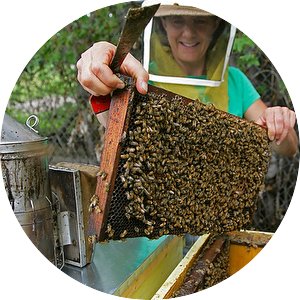
Marla Spivak

Marla Spivak

Professor
Apiculture / Social Insects

Mailing Address:

Room 219 Hodson Hall
1980 Folwell Ave,
St. Paul, MN 55108

phone: (612) 624-4798
fax: (612) 625-5299

E-mail: spiva001@umn.edu

Bee Lab Web Site

Education:

B.A. Humboldt State University, Arcata, CA, 1978, Biology
Ph.D University of Kansas, Lawrence, KS, 1989, Entomology

Research:

Hygienic behavior in honey bees as mechanism of disease resistance and as a defense against the parasitic mite, Varroa jacobsoni.

Neuroethological mechanisms underlying hygienic behavior: Bees that perform the behavior are particularly responsive to olfactory signals from diseased and parasitized brood, which may be mediated by senstizing effects of particular biogenic amines in the bee brain.

Bumblebees: rearing, ecology, pollination, social behavior and mating systems

Teaching:

Ent 4021 Honey Bees and Insect Societies (Spring semester)

Ent 4022 Bee Management (Intersession)

Ent 8061 Scientific Communication and Ethics (co-teach Fall semester)

Extension Activities:

Regional Apiculture Outreach Program (includes Minnesota, North Dakota, South Dakota, Iowa, Wisconsin).

Beekeeper's Management Short Course (March).

Honey Bee Queen Rearing Short Course (July).

Professional Activities:

American Association for Professional Apiculturists (AAPA) – Vice president

Apidologie – US co-Editor http://www.edpsciences.org/docinfos/INRA-APIDO/

Recent Publications:

Goode K, Huber Z, Mesce KA, Spivak, M. (2005) The relationships of honey bee (Apis mellifera) behaviors in the context of octopamine neuromodulation: hygienic behavior is independent of sucrose responsiveness and foraging ontogeny. Hormones and Behavior 49: 391-397.
Download PDF File

Ibrahim A, Spivak M. (2005) The relationship between hygienic behavior and suppression of mite reproduction as honey bee mechanisms of resistance to Varroa destructor. Apidologie 37: 31-40.
Download PDF File

Gekker G, Hu S, Spivak M, Lokensgard JR, Peterson PK (2005) Anti-HIV-1 activity of propolis in CD4+ lymphocyte and microglial cell cultures. J. Ethnopharmacology 102: 158-163.
Download PDF File

Mondragon L, Spivak M, Vandame R (2005) A multifactorial study of the resistance of Africanized and hybrid honey bees Apis mellifera to the mite Varroa destructor over one year in Mexico. Apidologie 36: 345-358.
Download PDF File

Flores JM, Spivak M, Guiterrez I (2005) Spores of Ascosphaera apis contained in wax foundation can pass on chalkbrood in honey bees. J. Invertebr. Pathol. 108: 141-144.
Download PDF File

Spivak M, Masterman R, Ross R, Mesce KA (2003) Hygienic behavior in the honey bee (Apis mellifera L.) and the modulatory role of octopamine. J. Neurobiol. 55: 341-354.
Download PDF File

Gramacho KP , Spivak M (2003) Differences in olfactory sensitivity and behavioral responses among honey bees bred for hygienic behavior. Behav. Ecol. Sociobiol. 54: 472-479.
Download PDF File

Lapidge K., Oldroyd B., Spivak M (2002) Seven suggestive quantitative trait loci influence hygienic behavior of honey bees.   Naturwissenschaften 89: 565-568.
Download PDF File

Spivak M, Reuter GS (2001) Resistance to American foulbrood disease by honey bee colonies, Apis mellifera , bred for hygienic behavior. Apidologie 32: 555-565.
Download PDF File

Masterman R, Ross R, Mesce K, Spivak M (2001) Olfactory and behavioral response thresholds to odors of diseased brood differ between hygienic and non-hygienic honey bees (Apis mellifera L.) J. Comp Physiol. A 187: 441-452
Download PDF File

Arathi HS, Spivak M (2001) Influence of colony genotypic composition on the performance of hygienic behavior in the honey bee ( Apis mellifera L). Animal Behavior 62: 57-66.
Download PDF File

Spivak M, Reuter GS (2001) Varroa jacobsoni infestation in untreated honey bee (Hymenoptera: Apidae) colonies selected for hygienic behavior. J. Econ. Entomol 94(1): 326-331.
Download PDF File

Spivak M (1996) Honey bee hygienic behavior and defense against Varroa jacobsoni. Apidologie 27: 245-260.

Extension Publications:

Spivak M, Reuter GS (2005) A Sustainable Approach to Controlling Honey Bee Diseases and Varroa Mites. SARE Agricultural Innovations-03AGI2005 Fact Sheet
Download PDF File

Spivak, M., Reuter, G. S. 1996. Video: Beekeeping in Northern Climates. Minnesota and Wisconsin Extension Services. Distribution Service #VH-6553 (or as Educational Package with Manual, EP-6684).
Order videotape here

Spivak, M., Reuter, G. S. 1994. Video: Successful Queen Rearing. Department of Entomology and Minnesota Extension Service Distribution #VH6335.
Order videotape here

Spivak, M., Reuter, G.S. 1993. Successful Queen Rearing Short Course Manual. 75pp. Department of Entomology and Minnesota Extension Service Distribution # MI6346. (educational packet Dist. # EP6347)
Order manual here

Furgala, B., Spivak, M., Reuter, G.S. 1993. Beekeeping in Northern Climates: Short Course Manual. 55pp. Distribution Number: MI-6683.
Order manual here

Technician ('Gary'-of-all-trades)

Gary S. Reuter

Graduate students:

Michael Simone

Jodi Swanson

Katie Lee

Recent Graduates:

Ian Burns

Elaine Evans

Kathy Jez

Abdullah Ibrahim

Rebecca Masterman


The University of Minnesota is an equal opportunity educator and employer.