
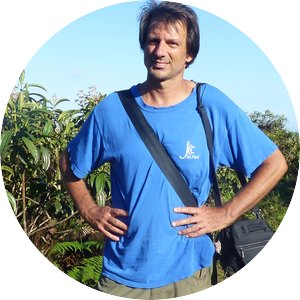
1980 Folwell Avenue
St. Paul, MN 55108
United States
B.S. 1988. University of California, Berkeley. Conservation and Resource Studies.
M.S. 1991. University of Delaware, Newark. Entomology and Applied Ecology.
Ph.D. 1995 University of California, Davis. Entomology.
Areas of Interest
Parasitoid biology, biological control, conservation, Galapagos
Teaching
I teach Insect Behavior (ENT 4231) in the spring of odd-numbered years and Biological Control (ENT 5341) in the spring of even-numbered years. I have also co-taught an interdisciplinary class on ecological risk assessment.
Research
I am currently involved in research on the avian parasite Philornis downsi (Diptera: Muscidae) that has invaded the Galapagos Islands where it is attacking Darwin's Finches. This work takes place in the Galapagos as well as mainland Ecuador and Trinidad & Tobago. I have also done research on naturally-occurring biological control of soybean aphid in its native Asia in Japan and China on a number of occasions since 2001.
Most of the projects in my lab focus on host-parasitoid interactions and biological control. Investigations range from genetics to community ecology with an emphasis on behavioral, population and evolutionary ecology of parasitoids within the context of biological control. Current projects include classical and conservation biological control of the soybean aphid in the United States, classical biological control of a parasite of Darwin’s finches in the Galapagos Islands, and classical biological control of the imported cabbageworm in the United States. More generally, interests in the lab focus on aspects of host specificity in parasitoids, indirect interactions in natural and agricultural systems, sex determination in parasitoid wasps, evolution of parasitoid reproductive strategies, and ecosystem services (biological control) associated with biofuel cropping systems.
Select Publications
Google Scholar link for George Heimpel
2018
Boulton, R. A. & G. E. Heimpel. 2018. Mind the gap: the evolution of oviposition site and specialisation in the parasitoid superfamily Chalcidoidea. Biological Journal of the Linnaean Society 124:213-227.
Boulton R. A., Bulgarella M., Ramirez I.E., Causton C.E. 2018. Management of the invasive avian parasitic fly, Philornis downsi, in the Galapagos Islands: is biological control a viable option? Island Invasives 2017; Dundee, Scotland.
Brodeur, J., P. K. Abram, G. E. Heimpel, and R. H. Messing. 2018. Trends in biological control: public interest, international networking and research direction. BioControl 63:11-26.
Desneux, N., L. Monticelli, C. Luo, M.K, Asplen, C.M. Brady, G.E. Heimpel, K.R. Hopper, K.M. Oliver & J.A. White. 2018. Intraspecific variation in facultative symbiont infection among native and exotic pest populations: potential implications for biological control. Biological Control 116:27-35.
Fessl, B., G. E. Heimpel, and C. E. Causton. 2018. Invasion of an avian nest parasite, Philornis downsi, to the Galápagos Islands: Colonization history, adaptations to novel ecosystems, and conservation challenges. Pages 213-266 in P. G. Parker, editor. Disease Ecology: Social and Ecological Interactions in the Galapagos Islands. Springer, Dordrecht, The Netherlands.
Heimpel, G.E. & M.J. Cock. 2018. Shifting paradigms in the history of classical biological control. BioControl. 63:27-37.
Hopper, K.R., K.L. Kuhn, K. Lanier, J.H. Rhoades, K.M. Oliver, J.A. White, M.A. Asplen & G.E. Heimpel. 2018. The defensive aphid symbiont Hamiltonella defensa affects host quality differently for Aphelinus glycinis versus Aphelinus atriplicis. Biological Control
Karp, D.S., R. Chaplin-Kramer, T.D. Meehan . . . G.E. Heimpel . . . (110 other authors). 2018. Crop pests and predators exhibit inconsistent responses to surrounding landscape composition. Proceedings of the National Academy of Sciences (USA) 115(33): E7863-E7870.
Kaser, J.M & G.E. Heimpel. 2018 Impact of the parasitoid Aphelinus certus on soybean aphid populations. Biological Control 127: 17-24.
Mason, P. G., M. J. W. Cock, B. I. P. Barratt, J. Klapwijk, J. C. van Lenteren, J. C. Brodeur, K. A. Hoelmer, and G. E. Heimpel. 2018. Best practices for the use and exchange of invertebrate biological control genetic resources relevant for food and agriculture. BioControl 63:149-154.
Mills, N.J. & G.E. Heimpel. 2018 Could increased understanding of foraging behavior help to predict the success of biological control? Current Opinion in Insect Science 27:26-31.
Sage, R., R.A. Boulton, P. Lahuatte, C.E. Causton, R. Cloutier & G.E. Heimpel. 2018. Environmentally cued hatching in the bird parasite Philornis downsi (Diptera: Muscidae). Entomologia Experimentalis et Applicata. 166: 752-760.
Tena, A., M. Senft, N. Desneux, J. Dregni & G.E. Heimpel. 2018. The influence of aphid-produced honeydew on parasitoid fitness and nutritional state: a comparative study. Basic and Applied Ecology 29: 55-68.
Wyckhuys, K.A.G., P. Wongtiem, A. Rauf, Thancharoen, G.E. Heimpel, T.T.N. Le, M.Z. Fanani, G.M. Gurr, J.G. Lundgren, D.D. Burra, L.K. Palao, G. Hyman, I. Graziosi, X.V. Le, M.J.W. Cock, T. Tscharntke, , S.D. Wratten, V.L. Nguyen, M.S. You, Y.H. Lu, J.W. Ketelaar, G. Goergen, P. Neuenschwander. 2018. Continental-scale suppression of an invasive pest by a host-specific parasitoid underlines both environmental and economic benefits of arthropod biological control. PeerJ 6: e5796.
2017
Boulton, R. A. and Heimpel, G.E. 2017. Potential for biological control of a parasite of Darwin's finches. Pages 23-28 in R. G. Van Driesche and R. C. Reardon, editors. Suppressing Over-Abundant Invasive Plants and Insects in Natural Areas by Use of their Specialized Natural Enemies. FHTET, USDA Forest Service, Morgantown, WV, USA.
Brodeur, J., A. E. Hajek, G. E. Heimpel, J. J. Sloggett, M. Mackauer, J. K. Pell, and W. Völkl. Predators, parasitoids and pathogens. 2017. in H. F. van Emden, editor. Aphids as Crop Pests - Second Edition. CABI.
Bulgarella, M., M. A. Quiroga, R.A. Boulton, I.E Ramirez, R.D. Moon, C.E. Causton, and G. E. Heimpel. 2017. Life cycle and host specificity of the parasitoid Conura annulifera (Hymenoptera: Chalcididae), a potential biological control agents of Philornis downsi (Diptera: Muscidae) in the Galapagos Islands. Annals of the Entomological Society of America 110: 317-328.
Delvare, G., G. E. Heimpel, H. Baur, D. D. Chadee, R. Martinez, and S. A. Knutie. 2017. Description of Brachymeria philornisae sp n. (Hymenoptera: Chalcididae), a parasitoid of the bird parasite Philornis trinitensis (Diptera: Muscidae) in Tobago, with a review of the sibling species. Zootaxa 4242:34-60.
Heimpel, G.E. 2017. Could biological control protect Darwin’s finches from an invasive parasite? Biocontrol News and Information 38: 21N-22N.
Heimpel, G.E. 2017. Message from the president: Interdisciplinary biological control. IOBC-Global Newsletter Issue 101 (June 2017).
Heimpel, G.E. 2017. President’s Column: Biological Control in Social Media. IOBC-Global Newsletter Issue 102 (December 2017).
Heimpel, G.E. & N.J. Mills. 2017. Biological Control: Ecology and Applications. Cambridge University Press. Cambridge, U.K.
Hopper, K. R., K. Lanier, J. H. Rhoades, K. A. Hoelmer, W. G. Meikle, G. E. Heimpel, R. J. O'Neil, D. G. Voegtlin, and J. B. Wooley. Host specificity of Aphelinus species collected from soybean aphid in Asia. Biological Control 115: 55-73.
Weis, J. J., P. J. Ode, and G. E. Heimpel. 2017. Balancing selection maintains sex determining alleles in multiple-locus complementary sex determination. Evolution 71:1246-1257.
2016
Asplen, M. K., J. M. Chacon, and G. E. Heimpel. 2016. Divergent sex-specific dispersal by a parasitoid wasp in the field. Entomologia Experimentalis et Applicata 159: 252-259.
Heimpel, G.E. 2016. We need more disease vector biological control. IOBC-NRS Newsletter 38: in press
Heimpel, G.E. 2016. Message from the president. IOBC-Global Newsletter Issue 100 (December 2016).
Kaiser M.C. & Heimpel GE. 2016. Parasitoid-induced transgenerational fecundity compensation in an aphid. Entomologia Experimentalis et Applicata 159: 197-206.
Kantar, M. B., C. E. Tyl, K. M. Dorn, X. Zhang, J. M. Jungers, J. M. Kaser, R. R. Schendel, J. O. Eckberg, B. C. Runck, M. Bunzel, N. R. Jordan, R. M. Stupar, M. D. Marks, J. A. Anderson, G. A. Johnson, C. C. Scheaffer, T. C. Schoenfuss, B. Ismail, G. E. Heimpel, and D. L. Wyse. 2016. Perennial grain and oilseed crops. Annual Review of Plant Biology 67:703-729.
Lahuatte, P., M. P. Lincango, G. E. Heimpel, and C. E. Causton. 2016. Rearing larvae of the avian nest parasite, Philornis downsi (Diptera: Muscidae) on chicken blood-based diets. Journal of Insect Science 16:84; 81-87.
Mohl, E. K., E. Santa-Martinez, and G. E. Heimpel. 2016. Interspecific differences in milkweeds alter predator density and the strength of trophic cascades. Arthropod-Plant Interactions 10:249-261.
Ode, P.J. & G.E. Heimpel. 2016. Editorial overview: Parasites/parasitoids/biological control: Communities without parasitoids? Current Opinion in Insect Science 14: viii- x.
Tena, A., F. L. Wackers, G. E. Heimpel, A. Urbaneja, and A. Pekas. 2016. Parasitoid nutritional ecology in a community context: the importance of honeydew and implications for biological control. Current Opinion in Insect Science 14:100-104.
Weis, JJ, Gray H & Heimpel GE. 2016. High hyperparasitism of Cotesia rubecula (Hymenoptera: Braconidae) in Minnesota and Massachusetts. Journal of the Kansas Entomological Society 89: 385-389.
Students Advised
Current:
- Sabrina Celis (Ph.D.)
- Ismael Ramirez Moreno (Ph.D.)
- Alyssa Gooding (Ph.D.) - EEB Student
Past:
- Mary Marek-Spartz (Ph.D., 2022)
- Hannah Gray (Ph.D., 2020. co-advised with David Andow)
- Jonathan Dregni (M.S., 2020)
- James Miksanek (Ph.D., 2020)
- Eric Middleton (Ph.D. 2020; co-advised with Ian MacRae)
- Ismael Ramirez (M.S. 2018)
- Joe Kaser (Ph. D. 2016)
- Matthew Kaiser (Ph.D.) - EEB student
- Emily Mohl (Ph.D. 2014)
- Megan Carter (M.S. 2013)
- Thelma Heidel (Ph.D. 2012; co-advised with David Ragsdale, Texas A&M University)
- Christine Dieckhoff (Ph.D. 2011)
- Jeremy Chacón (Ph.D. 2010)
- Annie-Eve Gagnon (Ph.D. 2010, co-advised with Prof. Jacques Brodeur, Montreal University)
- Marlijn Hoogendoorn (Ph.D. 2003)
- Cynthia Hsu (Ph.D. 2006)
- Jana Lee (Ph.D. 2004)
- Jonathan Lundgren (M.S. 2000)
Post-doctoral Associates
Current:
- Carl Stenoien
Past:
- Dawn Olson (1998)
- Henry Fadamiro (1998-1999)
- Vivian Osuji (2000-2002)
- Laura Weiser (2002-2003
- Zhishan Wu (1999-2004)
- Susanna Acheampong (2004-2005)
- Robert Koch (2005-2006)
- Nicolas Desneux (2006)
- Jetske De Boer (2005-2006)
- Kris Wyckhuys (2005-2007)
- Zeynep Sezen (2007-2008, 2011)
- Mark Asplen (2008-2013)
- Antonio Biondi (2013)
- Julie Peterson (2011-2014)
- Milan Plecas (2014-2015)
- Jerome Weis (2014-2016)
- Mariana Bulgarella (2014-2016)
- Rebecca Boulton (2016-2017)
- Kelton Welch (2016-2017)